
Best Espresso Machine for Beginners Under $500 (2026 Ultimate Guide)
Direct Answer First: Buying your first espresso machine can feel like a high-stakes guessing game — spend too little and you get watery coffee that tastes no better than instant pods, spend too much and you're stuck on a steep learning curve a thousand dollars deep. The good news: under $500, the home barista market has shifted dramatically, and you no longer have to compromise. We didn't just read spec sheets — we cross-checked every model against real Reddit threads, YouTube teardown tests, and long-term owner complaints so you know exactly what the listing photos won't show you before you buy. This guide breaks down the best espresso machine for beginners under $500 across six tested models, so you can pick the one that actually fits how you make coffee.

Quick-Verdict Box (Our Top Recommendations)
Chefman Crema Supreme (3L)
Built-in grinder, a massive tank, and a complete 58mm barista kit for a true budget price.
View on AmazonKndko Fully Automatic
Zero mess, zero portafilter hassle. Grinds, tamps, brews, and cleans up with one single touch.
View on AmazonElectactic Silver Edition (2.8L)
Features a 20% wider clog-crushing chute designed specifically to stop oily beans from jamming.
View on AmazonHiBREW H10Plus
Dual PID loops, a 3-way solenoid valve, and custom pre-infusion. Unmatched control under $500.
View on Amazon6 Best Espresso Machines for Beginners Under $500
| Model | Best For | Key Spec | Rating |
|---|---|---|---|
| Chefman Crema Supreme | High-volume households | 3.0L tank / 30 grind settings | 4.1 / 5 |
| Kndko Automatic | Hands-off convenience | 20-bar pump / super-automatic | 4.3 / 5 |
| Electactic (Almond) | First-time beginners | 58mm portafilter / 2.3L tank | 4.4 / 5 |
| Electactic (Silver) | Dark roasts + big batches | 2.8L tank / conical grinder | 4.4 / 5 |
| Philips 2200 Series | Purist bean-to-cup fans | Ceramic grinder / AquaClean | 3.8 / 5 |
| HiBREW H10Plus | Tight counter, big control | PID temp control / pressure gauge | 3.7 / 5 |

1. Chefman Crema Supreme (15-Bar, 3L)
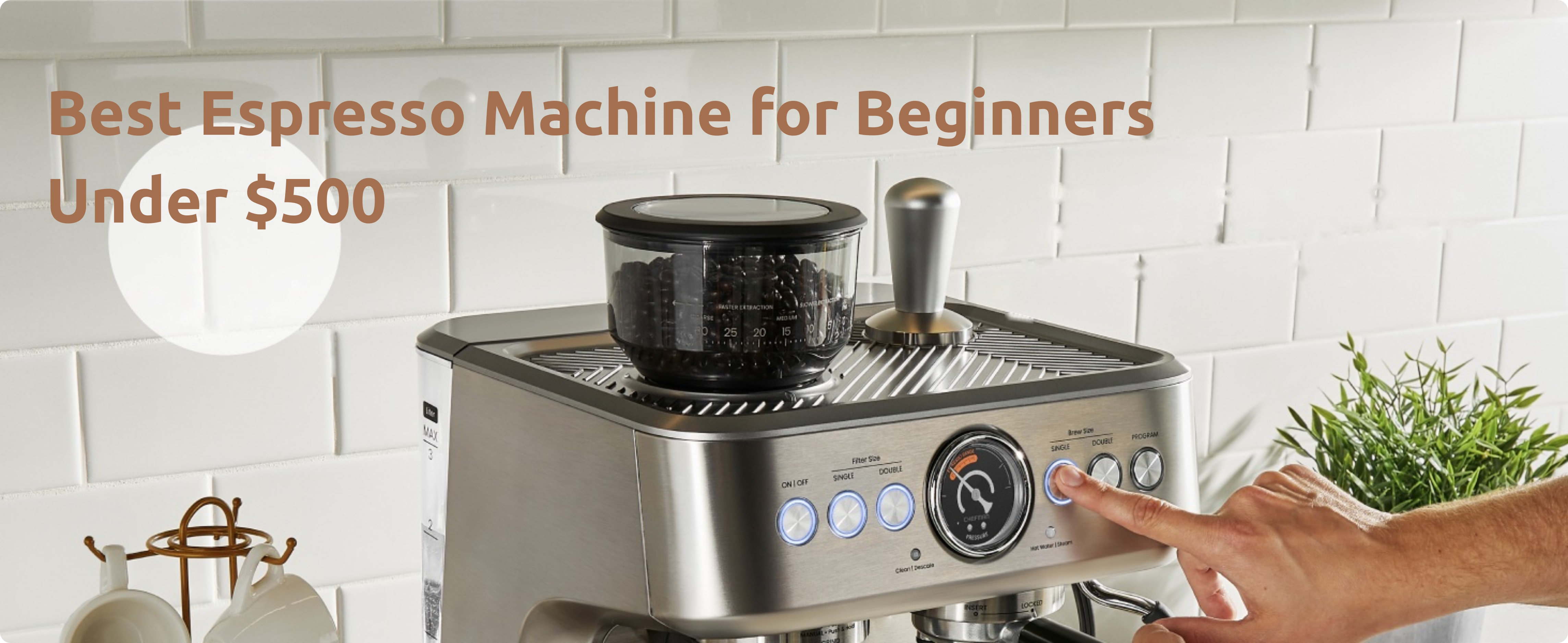
If you want a complete, café-style setup without the intimidating price of a high-end machine, the Chefman Crema Supreme is a genuine value-saver — famous brands charge upwards of $700 for a built-in grinder, and Chefman delivers a full semi-automatic experience for well under $500. It features an integrated conical burr grinder with 30 grind settings, a commercial-standard 58mm portafilter, a massive 3L removable tank, and a live pressure gauge so beginners can watch their extraction happen in real time. Note: Amazon lists this exact machine under more than one product code — those are the identical internal build, not a different product.
- Choking / blocking complaints: The most common issue on r/espresso — a fine grind or an over-tight tamp can fully choke the machine, blocking the pressure-release valve so coffee stops flowing. Owners recommend staying on the coarser side and tamping lightly.
- Spare-parts crisis outside the US: Reddit users outside the US (Mexico, Bangladesh, and similar markets) report no official spare parts or after-sales repair support. A broken part usually means an expensive eBay import with steep shipping fees.
- Milk-steaming learning curve: New users find the steam wand tricky to control at first — plan for a few practice pitchers before your microfoam looks café-worthy.
Pros
- Full accessory kit included (tamper, milk pitcher, grinding funnel)
- Fast-heating 1450-watt system
- Drip tray doubles as hidden accessory storage
- Unbeatable value for a built-in-grinder setup
Cons
- Grinder can clog with very oily, dark roast beans — stick to medium or dry roasts
- Chokes easily if you grind too fine or tamp too hard
- No official spare parts support outside the US
Busy households that want high volume without constant refilling and don't mind a short pause between extraction and frothing.
Purge 3-5 beans through the grinder any time the machine has sat idle overnight, and keep your grind on the coarser side with a light tamp to avoid the choking issue owners report most often.
Wash the large tank regularly to prevent biofilm buildup, wipe the metal-wrapped housing to keep its finish, and flush the steam wand immediately after texturing milk. If you're outside the US, treat this as an appliance you self-maintain — replacement parts are not locally supported.

2. Kndko Fully Automatic Espresso Machine
If measuring grounds, manual tamping, and cleaning up sloppy coffee pucks feels overwhelming, the Kndko is built for absolute beginners who want speed over craft. Under a high-pressure 20-bar system, it automates powder feeding, pressing, brewing, and waste removal internally, with a one-click panel for Espresso, Cappuccino, Ristretto, or Americano, plus smart alerts for low water, low beans, a full waste tray, or an overdue descale.
- "White label" truth: Reddit investigations found this is a generic Chinese white-label machine sold under multiple names (like "COWSAR 20-Bar") — there's no single dedicated manufacturer support line to call.
- Review authenticity concerns: The r/espresso community flags a large share of this listing's Amazon ratings as likely bot-generated or sponsored — weigh the star rating with some caution.
- Temperature & noise complaints: Independent kitchen-gear reviewers report the coffee can come out lukewarm rather than truly hot, and the machine runs noticeably loud during operation.
Pros
- Zero mess on the counter, compact 7-inch footprint
- Straight-drop grinder channel resists stale powder residue
- Integrated auto-clean mechanism
- True one-touch bean-to-cup operation
Cons
- Smaller 1.5L tank needs more frequent refilling
- Generic white-label build with no dedicated brand support
- Coffee can run lukewarm; runs loud when brewing
Convenience-seeking drinkers who prefer light-to-medium roasts and want hands-off, bean-to-cup automation over a hands-on barista experience.
Avoid heavily roasted, oily beans — the shallow hopper angle makes them prone to jamming. Keep a small wooden paddle nearby to nudge stubborn beans into the grinding throat if you do use darker roasts.
Manually remove and lubricate the internal brew group every 2-3 months with food-grade silicone grease to keep the drive gears from jamming during the automatic self-clean cycle.
3. Electactic 15-Bar Machine (Almond, 2.3L)
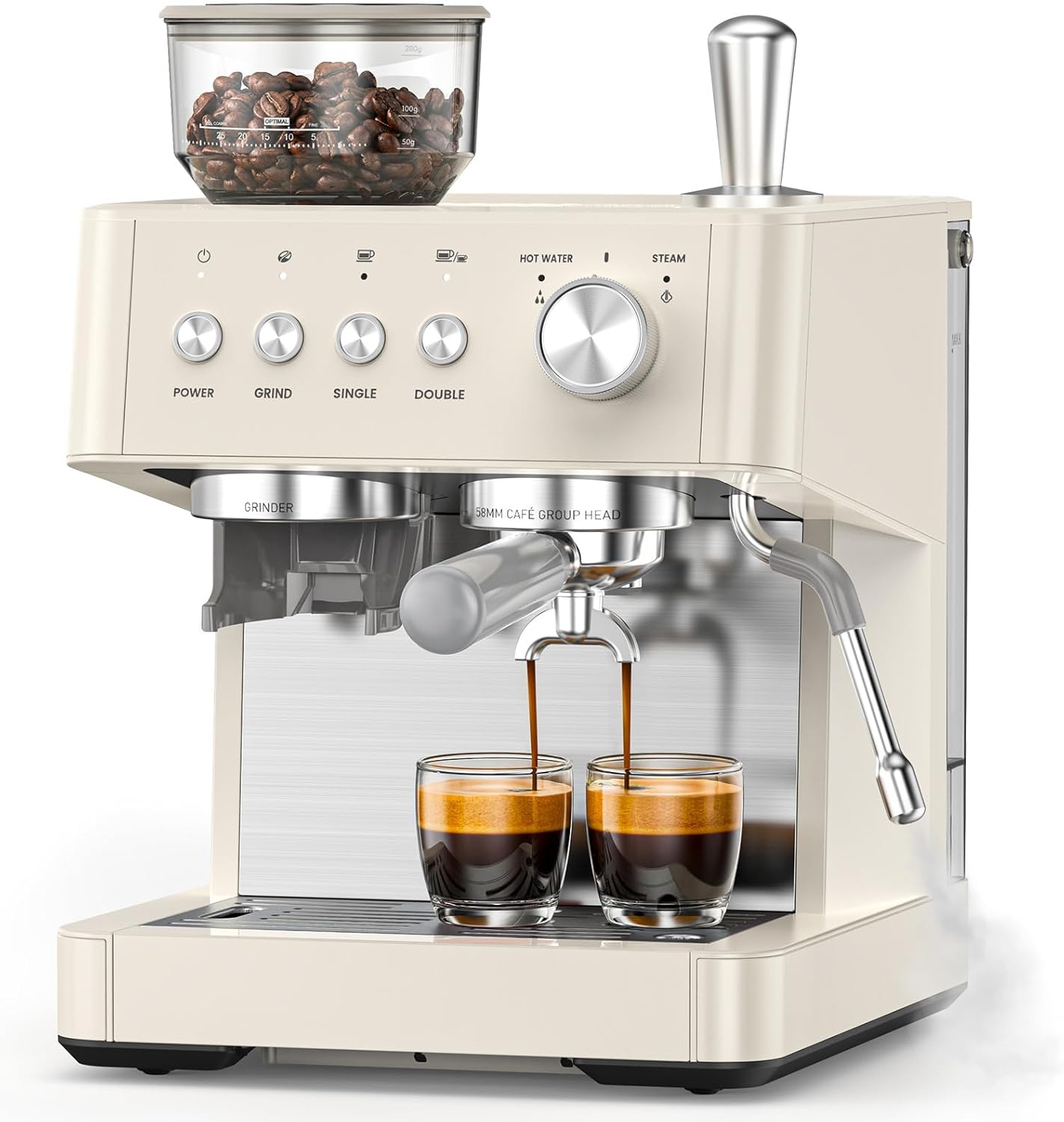
One of the biggest complaints with budget all-in-one machines is that oily, dark roast beans clog the grinder. The Electactic Almond directly targets that problem with a 20% wider polished chute and a reinforced helical auger that ejects grounds instantly, plus a low-pressure pre-infusion stage before the full 15-bar extraction and a generous 2.3L tank for back-to-back drinks.
- Grinder setting quirk: YouTube testers found you cannot switch the grinder to a "Fine" setting while beans are still loaded in the hopper — doing so jams the mechanism. You can switch to "Coarse" with beans in, but for a fine grind you need to empty the hopper first.
- Hidden double-wall baskets: Two pressurized (double-walled) baskets are stored in a tool box underneath the machine. Expert reviewers note these fake a nice crema for beginners but mute the true flavor and extraction quality — swap to the non-pressurized single-wall basket once you're ready for a professional-grade shot.
Pros
- Genuinely handles oily French or Italian roasts without locking up
- Unique retro Almond finish
- Includes both pressurized and non-pressurized baskets
Cons
- No digital touchscreen — classic physical buttons only
- Can't switch to a fine grind setting with beans still in the hopper
Beginner baristas who want a forgiving machine that produces good-looking cups right out of the box, with room to grow into commercial-style tools later.
Empty the hopper before dialing to a finer grind setting to avoid jamming the mechanism, then upgrade to the included unpressurized single-wall basket once you're confident with your grind size for a true, syrupy shot instead of artificial crema.
Don't let dark or flavored beans sit unchecked in the anti-clog grinder. Clean the internal static-reduction wire channel every 3 weeks with the included wire tool to avoid a full chute jam.

4. Electactic 15-Bar Anti-Clog Machine (Silver Edition)
If you like the anti-clogging design of the Almond edition but want a larger tank and a modern brushed-steel look, the Silver Edition is the upgrade. It keeps the signature 20% wider polished chute and reinforced helical auger for oily French and Italian roasts, and expands to a 2.8L reservoir so heavy-drinking households can pull multiple shots and froth lattes without refilling.
- Same internals, same quirks: This shares its almond sibling's grinder mechanism — you still need to empty the hopper before switching to a fine grind setting, and the stock baskets are pressurized (double-walled), which flatters crema but caps true extraction quality.
- Upgrade path: Swap to a non-pressurized single-wall basket, stored in the same under-machine tool box, once you're ready to chase real, unpressurized shots.
Pros
- Zero grinder jams with fine or oily grounds thanks to the anti-clog chute
- Good temperature management via low-pressure pre-infusion
- Generous accessory bundle
Cons
- Takes up more counter space due to the larger 2.8L tank
- Stock basket is pressurized — true extraction needs the included upgrade basket
Home baristas who want modern steel kitchen aesthetics along with a large water capacity for back-to-back entertaining.
Weigh your ground coffee with an external digital scale. Pressurized baskets forgive grind inconsistency but are still sensitive to over- or under-packing.
Empty the drip tray frequently, since back-to-back shots push extra pressure-release water downward. Give the anti-clog system a routine brush-out every week.
5. Philips 2200 Series Fully Automatic Machine (EP2220/14)
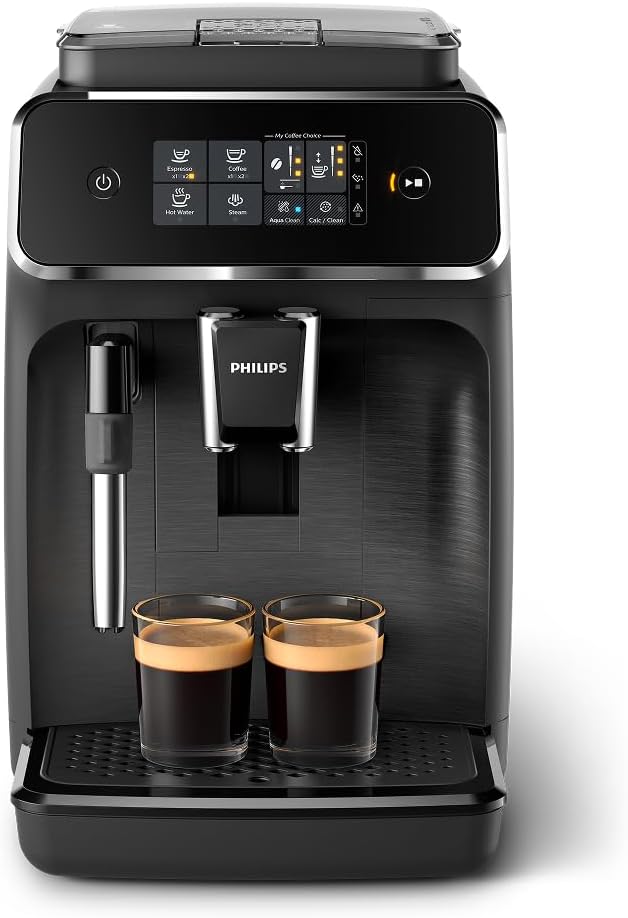
If you want the peace of mind of a legacy appliance brand, the Philips 2200 Series is a strong bet under $500. While most entry-level machines use steel conical burrs, Philips fits a 100% ceramic grinder that stays cool to protect subtle flavors, with a touch display for Espresso, Espresso Lungo, Americano, or Coffee across three strength levels, and a classic two-piece Pannarello wand that's genuinely easy for beginners to use.
- Dark roast jamming: r/superautomatic owners warn that oily dark roast beans clog the internal grinder and brew unit fast on this model — stick to medium or non-oily beans.
- The AquaClean filter trap: Philips advertises up to 5,000 cups before descaling is needed, but in genuinely hard-water areas the internal sensor can lock the machine and demand a descale well before 1,000 cups — don't rely on the headline number if your tap water is hard.
Pros
- Long-lasting ceramic grinder rated for up to 20,000 cycles
- Easy-access front-loading water reservoir and waste container
- Simple, beginner-friendly Pannarello wand
Cons
- Manual Pannarello wand rather than an automated milk carafe
- Oily dark roasts clog the grinder fast
- Hard water can trigger descale lockouts well before the advertised 5,000-cup mark
Purists who want genuine espresso extraction quality and hands-off grinding simplicity, without any metallic taint or complex intervention.
Push the adjustable strength setting on the touch display to its maximum profile when brewing milk drinks, so the espresso cuts cleanly through the dairy layer. Stick to medium roasts to protect the grinder.
Rinse the fully removable brewing group once a week under the tap. If your local water is hard, ignore the 5,000-cup filter claim and keep descaling solution on hand — plan on descaling well before then.

6. HiBREW H10Plus Programmable Machine
For beginners who want to learn the real science behind extraction rather than a simplified black box, the H10Plus punches well above its price with hardware you'd normally see on $1,000+ machines: dual PID loops holding the brew circuit (90–95°C) and steam circuit (125–150°C) independently, a commercial 3-way solenoid valve that purges the group head instantly after each shot, and a programmable 0–10 second pre-infusion cycle with a live shot timer on the display.
- Proprietary 3-lug portafilter (biggest downside): YouTube coffee experts flag that the 58mm portafilter uses a 3-lug locking system instead of the industry-standard 2-lug found on most commercial and café portafilters — you can't drop in a standard bottomless portafilter, only official HiBREW accessories fit.
- Quieter pump, cleaner puck: Blind tests show the Plus model's upgraded 3-way solenoid valve and Ulka pump make it noticeably quieter than the older H10A, with a dry, clean coffee puck after extraction.
- Steaming delay: The wand produces good microfoam texture but takes about 50–60 seconds to froth — slower than others at this price — and the machine needs roughly 4 minutes (or a manual purge) to cool back down to brew mode after steaming.
Pros
- Wood-handled tamper plus single and dual-wall non-pressurized baskets included
- Incredible shot consistency across light to dark roasts
- Quiet operation and clean, dry coffee puck after extraction
Cons
- No built-in grinder — pair it with a standalone espresso grinder
- Proprietary 3-lug portafilter locks you into HiBREW accessories
- Slow milk frothing and a long cooldown before the next shot
Enthusiastic espresso hobbyists who want full thermal and pressure control without giving up valuable counter space, and who already own (or plan to buy) a separate grinder.
Preheat the heavy 58mm portafilter by running a blank shot of hot water through it before loading grounds. This stops thermal loss from ruining your shot profile.
Back-flush the group head consistently. Because the unit is lightweight, avoid harsh abrasive scrubbing on the matte exterior to protect the metal finish underneath, and budget extra time after steaming for the unit to cool before your next shot.
Beginner's Buying Guide: How to Choose the Best Espresso Machine Under $500
1. Semi-Automatic vs. Super-Automatic
Semi-Automatic (Chefman, Electactic, HiBREW): best for those who want to learn tamping, manual milk steaming, and shot timing — a true barista experience at home.
Super-Automatic (Kndko, Philips): perfect for busy people who want fresh bean-to-cup coffee at the press of a single button, with zero mess and zero manual effort.
2. The Grinder Factor (Built-in vs. Standalone)
Machines with built-in grinders (Chefman, Electactic) save counter space and protect your wallet from an extra $150–$200 on a separate grinder. Standalone setups like the HiBREW H10Plus let you upgrade your grinder later for even greater extraction precision.
3. The Portafilter Size Matters
Many entry-level machines use small 51mm pressurized portafilters that mask bad technique but cap flavor potential. A 58mm commercial-standard portafilter lets your extraction mimic what you'd get from a high-end espresso bar — just watch for proprietary locking systems (like HiBREW's 3-lug design) that limit which third-party baskets and accessories will actually fit.
Frequently Asked Real-World Questions
Do all beginner espresso machines under $500 use the same bar pressure?
No. In this roundup, pump pressure ranges from 15 bar to 20 bar. A higher bar rating alone doesn't guarantee better espresso — basket type, grind consistency, and thermoblock recovery time matter just as much as the number printed on the box.
Is a built-in grinder actually better for a beginner than a separate grinder?
Built-in grinders save counter space and are easier to start with, but nearly every model here retains 1.5g to 2g of stale grounds between shots and works best with a quick purge before your first coffee of the day.
How much regular maintenance do these budget machines really need?
Expect weekly drip tray and steam wand cleaning at minimum. Super-automatic models need their brew group manually lubricated every 2-3 months, and hard tap water will push any of these machines to descale more often than the box claims.